


Land Use Board February Meeting Updates
Land Use Board February Meeting Updates

By: Roberta Walters
Published on February 18, 2026
On February 5, 2026, the Land Use Board met for their monthly meeting. Unfortunately, the agenda was not posted online prior to the meeting. In fact, a review of the Borough website shows the Land Use Board had not posted agendas prior to meetings since March 2025 (and no meeting minutes were posted between March and September 2025). The January and February 2026 agendas were posted to the website as of February 11th, which was well after their respective meetings.
The agenda for the meeting on February 5th, showed there were two topics for discussion:
- BRIEF REVIEW OF PRELIMINARY REVIEW OF CHANGES TO THE MASTER PLAN BY BOARD ENGINEER
- BOARD MEMBERS TO DISCUSS ORDINANCE CHANGES TO 2 FAMILY HOMES IN THE BOROUGH
Master Plan
After previous meeting minutes were approved and public portion was concluded, Chairman Powers turned the floor over to engineer Joseph Brosnan for a preliminary review of changes to the Master Plan.
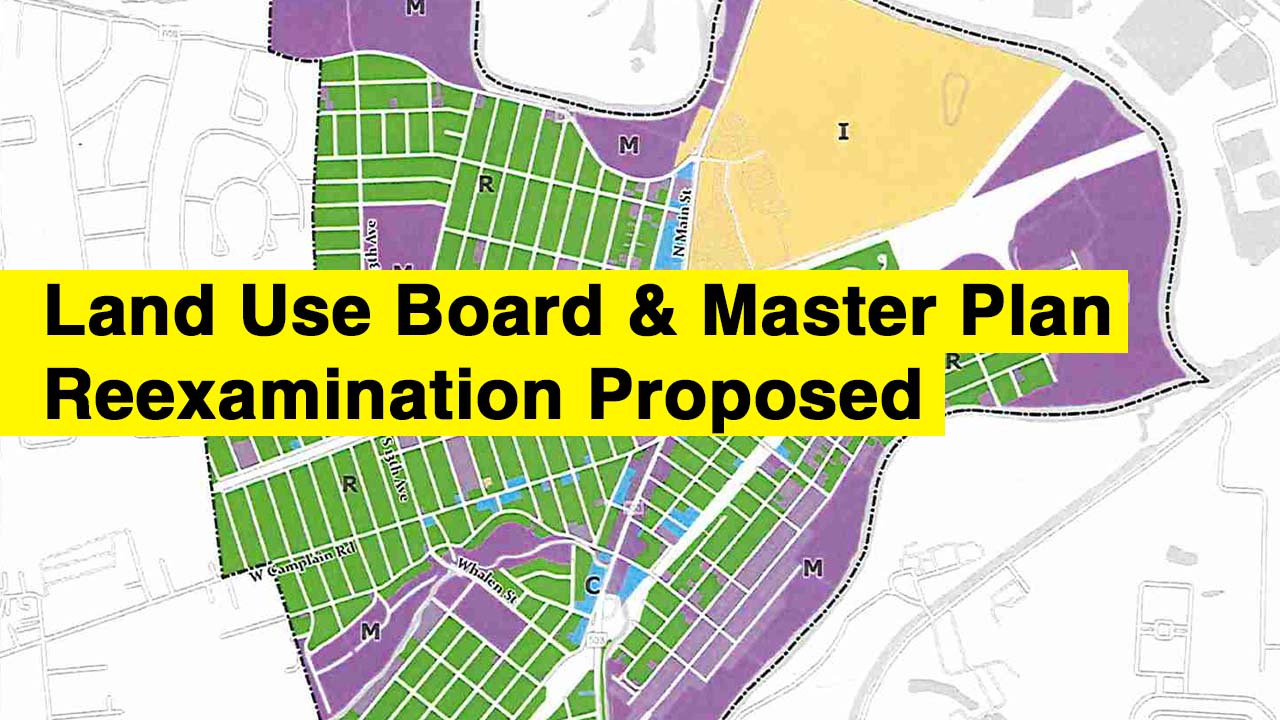
Mr. Brosnan identified the consolidation of residential zones into a single zone as a key driver of current problems. He also described confusion created by the newer municipal zoning tied to the South Main Street rehabilitation area, which historically had been commercial. He said one is that there were many confusions associated with the new municipal zone associated then to the South Main Street rehabilitation area, which historically was all commercial, stating:
"we have an opportunity to correct that and possibly replace that with a more enhanced zone. You can either bring it right back to the old commercial zoning that was associated with, or we could take some elements out of the South Main Street rehabilitation plan and build something like a high-density commercial zone along that corridor."
Mr. Brosnan stressed the urgency of the Borough's affordable housing obligation under the draft Housing and Fair Share Plan adopted last June. Stating we have until March 15th, which means only one meeting from now. Because of this deadline, Mr. Brosnan indicated "we have to have all of our housing zoned in, which if I recall correctly, Jim Kyle" (the Borough's Affordable Housing Planner who was hired under Resolution #2024-160) "identified that we would be able to accommodate all of that with either an updated redevelopment plan on the Rustic Mall site, which is problematic because we do not yet own it. And there are certain reasons why we cannot get into that." He also suggested an overlay zone could be used to provide the required realistic development potential, at least in theory.
Mr. Brosnan added that while the issues had been discussed previously, he did not believe the Board had taken formal action authorizing the work or requesting funding. He suggested the Board authorize preparation of a resolution and make a formal request to Council so funds could be allocated for the master plan update effort.
No formal action was taken at this meeting to allocate the funding needed for the master plan reexamination. Given the very tight deadline of March 15th, this raises a question as to how the work will proceed, what is the amount of funding needed for the master plan review, and at what point will this be formally discussed and approved?
Chairman Powers agreed and indicated the Board should proceed in that direction. Attorney Flynn stated he would contact the new Borough Administrator to confirm what items were still required to remain compliant for affordable housing purposes, and he reiterated that affordable housing compliance is the immediate priority due to the March 15 deadline.
Mayor Richard Onderko asked how many affordable housing units were involved. Attorney Flynn responded that the obligation would be satisfied through zoning tied to the Rustic Mall site, describing the number as 16 units.
When the Mayor asked about the timeframe for accomplishing the affordable housing goal, Attorney Flynn clarified that the law does not require the units to be built. It requires the Borough to provide a reasonable opportunity for affordable housing through proper zoning. He explained that because of limited vacant land and the impact of the Blue Acres program, the Rustic Mall site is treated as the only location in the Borough with realistic development potential. He emphasized that as long as the Borough adopts the required zoning and ordinances by March 15, it satisfies its obligation, regardless of whether construction ultimately occurs.
Two Family Housing
After the discussion on affordable housing concluded, Mayor Onderko asked how the Borough would fix the problem of two-family zoning on smaller lots such as 80-by-100 parcels. Mr. Brosnan outlined several options. The Borough could eliminate two-family zoning entirely, reintroduce prior locational requirements that limited where two-family housing could occur, or keep the newer sliding-scale residential zoning but pair it with a defined area-based approach that permits two-family housing only where lot size and location meet specific criteria.
Chairman Powers stated there had been extensive discussion among the engineer, Mayor, and attorney about the future of two-family homes. He said he was considering drafting an ordinance requiring any future two-family homes to be on at least a 100-by-100 lot, calling that the minimum acceptable standard. He asked Attorney Flynn whether adopting that minimum could make it effectively non-applicable for variance relief.
Attorney Flynn explained that imposing a 100-by-100 requirement as a condition of the use would make two-family housing a conditional use. That would require two-family applications to come before the Board for confirmation that the conditions are met, even if the lot is compliant. He also explained that an applicant could still seek use variance relief for a smaller lot, such as an 80-by-100 parcel, but the burden of proof would be very high, particularly if the Ordinance is grounded in documented Borough concerns such as overcrowding on small lots. He stated there is no reason the Borough could not adopt an ordinance like that and characterized it as consistent with sound planning.
Attorney Flynn explained that pursuing these zoning changes through a Master Plan Reexamination has a major procedural benefit. If Council adopts zoning changes that implement a Master Plan Reexamination, the Borough can avoid providing broad, property-by-property "super notice" to all owners in the affected zone.
If the Borough does not proceed through a Master Plan Reexamination, it would have to notice every property in the residential zone, meaning hundreds of certified mailings. Attorney Flynn described this as a key practical reason for updating the Master Plan before adopting major zoning changes.
Chairman Powers opened a broader discussion about ordinances and immediate changes related to two-family homes beyond the 100-by-100 concept. The discussion centered on the practical impacts of two-family conversions and the Borough's concerns about parking and overcrowding.
Housing Regulations
Board members asked whether the Borough could regulate the number of people living in a home. Attorney Flynn cautioned that directly restricting how many people can live in a house is legally risky. He stated you generally cannot set a hard cap on occupancy in a single-family home unless it ties into enforceable housing or property maintenance code standards, and he suggested an ordinance that attempts to limit occupancy by headcount would likely be vulnerable to a successful legal challenge if contested.
The conversation then turned to room and bedroom standards as a more defensible approach. Mr. Brosnan asked whether the Borough could regulate room sizes. Attorney Flynn indicated standards connected to bedrooms and room dimensions can be more appropriate zoning tools. Board members referenced small-bedroom minimums, including a 70 square foot figure, and discussed whether the borough could adopt requirements that prevent extremely small bedrooms that contribute to overcrowding pressure. Attorney Flynn indicated such approaches could be pursued.
Chairman Powers concluded that the issue warranted a subcommittee to develop recommendations and bring them back to the full Board. Attorney Flynn suggested a three-member subcommittee structure as appropriate given the Board's role as a Board of Adjustment. Members volunteered and were selected during the discussion, including the Chair. There was no vote on the creation of this subcommittee, rather it was created by consensus. The group indicated it would report back, ideally at the next meeting.
Mayor Onderko stated the Borough's rental registration Ordinance, adopted a few years earlier, had been helpful, including for identifying illegal apartments and basement arrangements. He expressed concern about privacy rights and said entry and inspection authority is clearer when a property is non-owner-occupied, while owner-occupied situations raise more barriers.
The Mayor also stated that New Jersey case law treats groups of unrelated people living together as a "family unit," meaning that the Borough's ability to regulate based solely on unrelated occupants can be limited. Attorney Flynn reinforced that point and emphasized that enforcement often hinges on physical infrastructure.
He explained that when a home is modified with dividers or features that functionally create separate units, such as separate utility connections or separate bathrooms, it becomes more defensible to treat it as an illegal two-family arrangement for zoning enforcement purposes. He also discussed how rental registration fees are typically meant to support cyclical inspections and described an approach where rental registration renewals trigger periodic inspections, such as every three years.
The discussion then focused on the legal limits of entering an owner-occupied home. The Mayor asked whether numerous cars outside could create an obligation for the owner to allow entry, referencing Fourth Amendment protections. Attorney Flynn stated that cars on the street do not constitute probable cause to enter someone's home, and even nine cars outside is not, by itself, probable cause for entry.
These are important topics which have real impact to Manville residents. The next Land Use Board meeting is on Thursday, March 5th at 6:30pm. It is open the public, and residents can attend to provide input into these changes, and to ask questions on how they may affect you.
More Stories

Library Roof Ordinance Pulled
Sep 22, 2026

Snow Parking Ordinance Adopted
Sep 19, 2026
Rustic Mall Acquisition Ordinance Introduced
Sep 18, 2026

Manville Celebrates Community Day
Sep 22, 2026